KOMBUCHA
A fermented tea for your digestive health
Kombucha is a naturally fermented tea made with a live culture called SCOBY (symbiotic culture of bacteria and yeast).
why make your own kombucha?
There’s something deeply satisfying about making something that’s alive. Kombucha isn’t just a drink, it’s a slow, living ritual. Making your own kombucha means you get to take part in that process, not just consuming, but creating. You know exactly what’s in it. You choose the ingredients. You taste the change. You wait. You notice.
This guide is here to walk you through it, slowly, simply, and with space to make it your own.
grow your own SCOBY
– the beginning –
You can always get a SCOBY from someone who already brews or you can easily grow your own. All it takes is time, patience, and a little store-bought kombucha.
Gather your ingredients:
- 250 ml of brewed black tea
- 12–15 g of sugar ( 1 tablespoon)
- 250–300 ml of raw, unflavoured kombucha(store-bought, unpasteurized)
- A clean glass jar (about 1 liter)
- A cloth or paper towel + rubber band
Notes:
- Black tea is best for growing your first SCOBY, it provides the right nutrients and stability.
- Don’t stir or shake the jar while the SCOBY is forming.
- If you see fuzzy mold (green, blue, or black), discard everything and start again, it should always be smooth and wet, never dry or fuzzy.
- You’ll want to cover your kombucha jar with a clean cloth and secure it with a rubber band so dust and fruit flies can’t get in, as they can easily contaminate your brew.
Instructions:
- Make your sweet tea – brew black tea (about 1 tsp / 1.5–2 g) in 250 ml of hot water. Stir in 12–15 g of sugar. Let it cool completely.
- Combine – pour the cooled sweet tea into your clean jar. Add the raw kombucha (including any sediment, that’s where the live cultures live).
- Cover and rest – cover the jar with a breathable cloth or paper towel, secured with a rubber band. Leave it in a warm, quiet spot (21–27°C), out of direct sunlight.
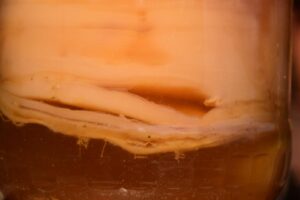
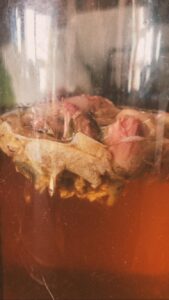
- Let it grow – over the next 1–4 weeks, a pale disc will begin to form on the surface, your SCOBY. It may look odd at first: cloudy, uneven, a little strange. That’s completely normal.
- It’s ready when…the SCOBY is considered ready once it’s around 5–10 mm thick (about the thickness of cardstock). At this point, it’s strong enough to brew your first batch.
How the SCOBY Grows
– Layer by Layer-
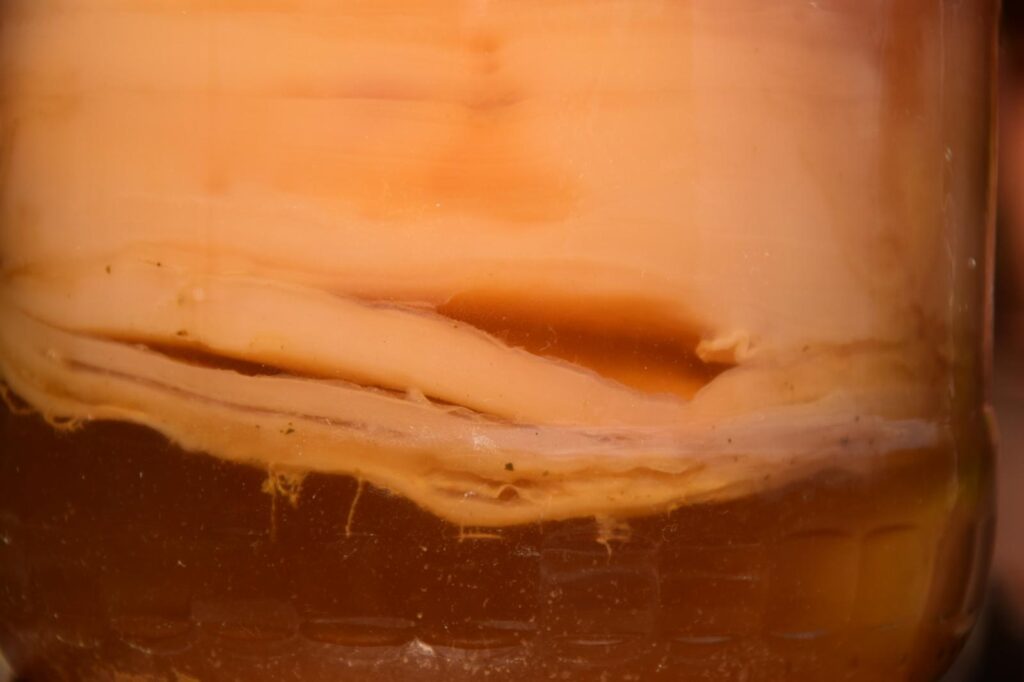
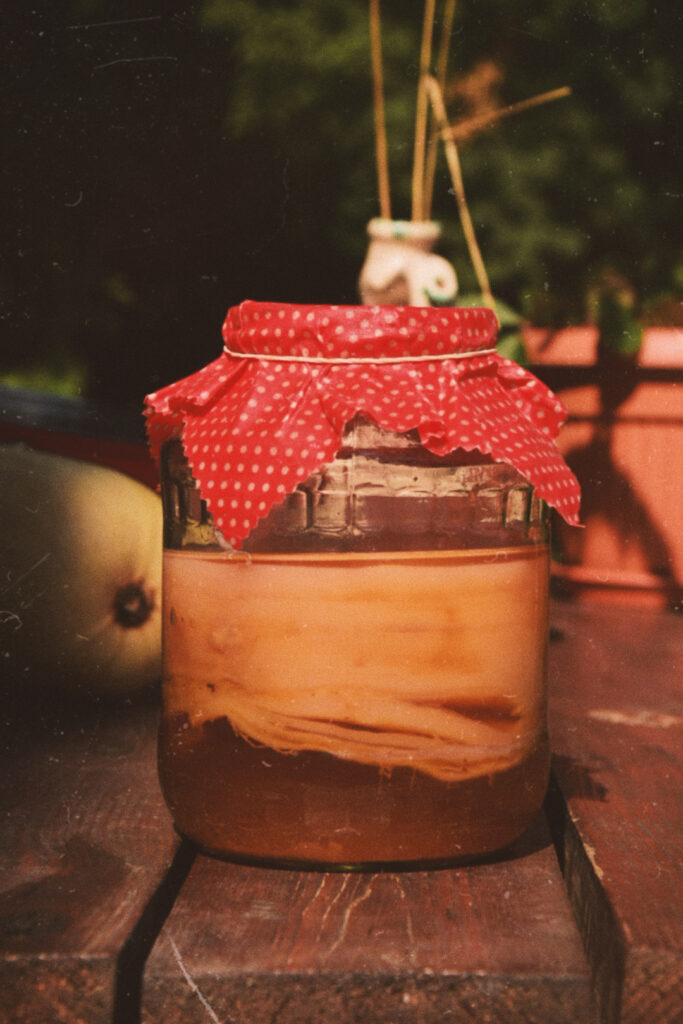
As kombucha ferments, the SCOBY forms new layers on the surface of the liquid. These layers are made primarily of cellulose produced by the bacteria. A new layer begins as a thin, transparent film and gradually thickens over several days. It forms where the liquid meets the air, so it’s important to keep the surface moist and never let it dry out, or the SCOBY can get damaged. With each new batch, another layer forms on top of the old one. Over time, you’ll notice your SCOBY getting thicker with multiple layers. You can peel these apart, use them for new batches, share or compost them.
SAFETY TIP: be careful with metal! Kombucha is acidic, and when it comes into contact with certain metals (like aluminum, copper, or iron), it can cause a chemical reaction that may damage your brew, or worse, leach harmful substances into it.
Avoid using metal containers, utensils, or lids during the brewing and fermentation process!
the first fermentation
– transforming sweet tea into kombucha
Introducing the SCOBY to the tea will initiate a symbiotic process where yeast and bacteria convert sugars into organic acids, gases, and a trace of alcohol, laying the foundation for your kombucha.
Ingredients:
- 1 Liter filtered water
- 3-4 g loose-leaf BLACK or GREEN tea (or 1–2 tea bags)
- 50-70 g sugar
- 1 SCOBY
- 100–200 ml starter liquid (from a previous batch or store-bought raw kombucha)
Guidelines:
- Temperature – keep between 20–30°C for best results
- Light – avoid direct sunlight. Store in a shaded spot
- Airflow – cover with a breathable cloth (no airtight lids)
- Cleanliness – use clean hands and tools, no harsh soaps or chemicals
- Location – store away from heat sources, strong odours, and other ferments
- Check for mould – fuzzy, green/blue/black? Toss and restart
INSTRUCTIONS:
- Brew the tea – bring the water to boil. Add your tea and steep for 5–10 minutes. Remove the leaves or tea bags.
- Sweeten it- while the tea is still warm, stir in the sugar until fully dissolved.
- Let it cool – hot tea can damage your SCOBY. Let the sweet tea cool to room temperature before moving on.
- Combine – pour the sweet tea into a clean glass jar. Add your SCOBY and the starter liquid.
- Cover & Ferment – cover the jar with a breathable cloth and secure it with a rubber band. Place it somewhere warm (21–27°C), out of direct light. Now, you just wait.
- Ferment for 5-10 days – Taste it after about 5 days. The longer it sits, the less sweet and more tart it becomes. When it tastes just right to you, it’s readyyyy!
BLack tea vs green tea
Black tea
produces deeper, full bodied and more robust flavours
Green tea
produces lighter, more floral, grassy, and delicate flavours
Both are great, and many brewers enjoy blending them to find the balance that suits their palate. As with most things in fermentation, it’s a process of trying, tasting, and finding out what you like.
the second fermentation
– the chapter of flavour & fizz-
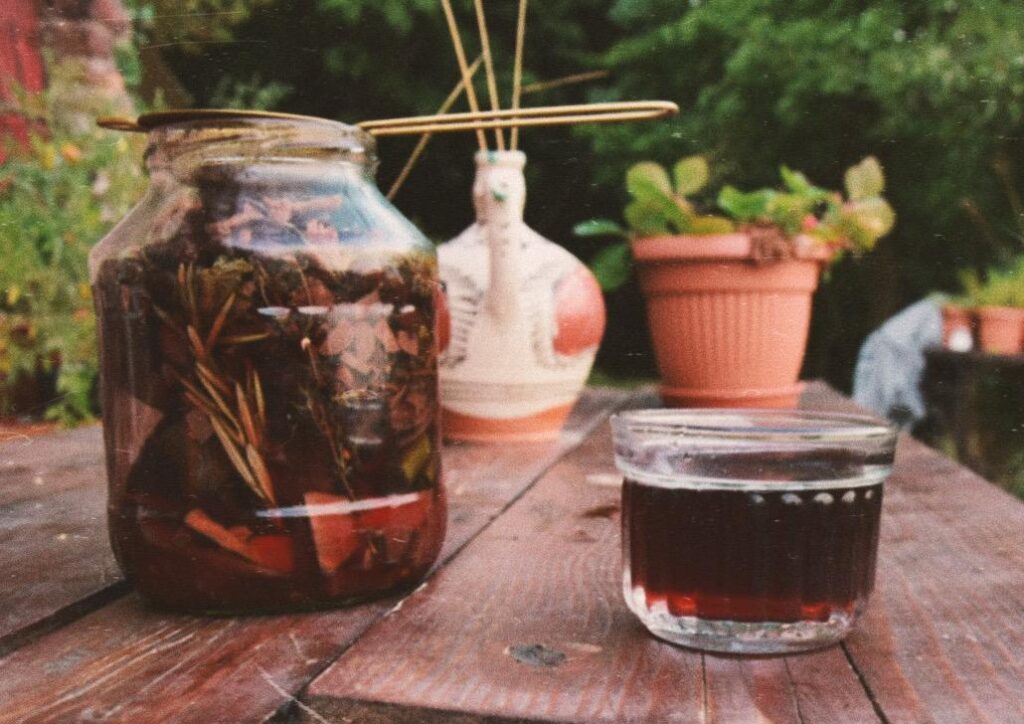
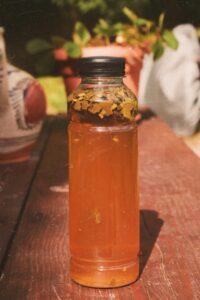
Second fermentation is simply bottling your finished kombucha and letting it sit for a few days with some flavouring, like fruit, juice, or herbs. The remaining yeasts feed on the sugars and create natural bubbles. It’s how we turn flat kombucha into something light, sparkling, and full of flavour.
Flavour
Primary fermentation gives kombucha its characteristic tang, but second fermentation lets you experiment. Want it fruity, floral, spicy, or herbal?
FIZZ
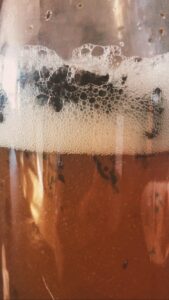
Carbon dioxide from the yeast creates natural bubbles. This is how kombucha gets that satisfying, soda-like sparkle.
Preservation
Proper second fermentation can help stabilize flavours and even slightly prolong shelf life.
FLAVOUR
examples to get you started:
- Fruits: berries, mango, peach, apple, pineapple, lemon
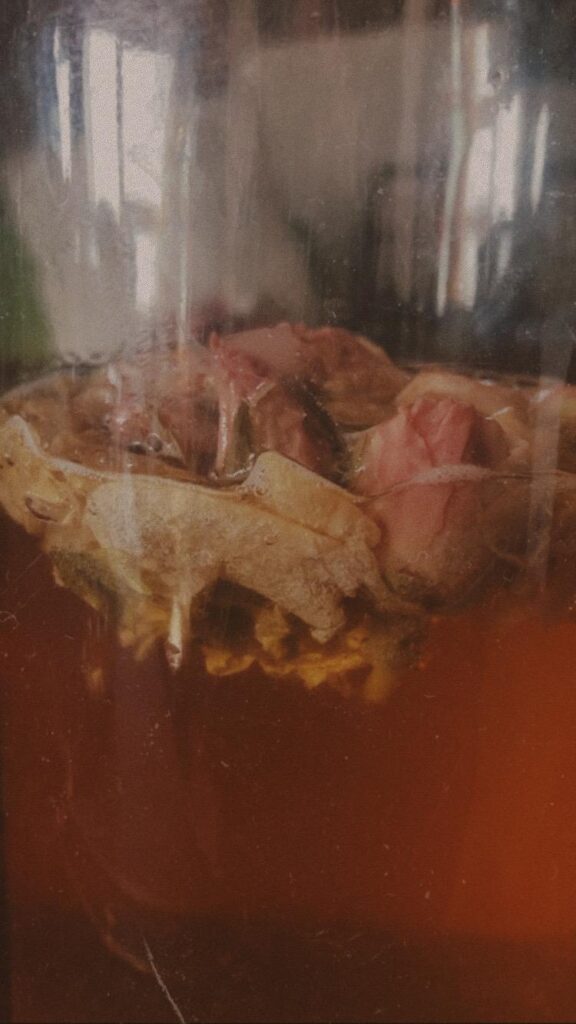
- Fresh or dried herbs & flowers: mint, basil, rosemary, lavender, hibiscus, elderflower, rose
- Spices: ginger, cinnamon, turmeric, vanilla
- Other: fruit juices, flavoured syrups, tea blends, coffee, mate…
This stage is my favourite part, where you can really start to have fun and get creative. You don’t need to be a flavour expert to get started, simple combos like strawberry and mint, ginger and apple, or even just a splash of fruit juice can turn your kombucha into something special.
my own kombucha crushes:
elderflower
Light, floral, and a little nostalgic.
earl grey
Bold, bergamot-flavoured, grounding.
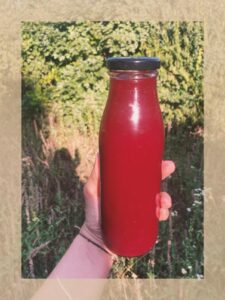
Beetroot juice
Earthy, vibrant, and refreshing.
INstructions:
- Remove your SCOBY from the primary fermentation vessel and reserve 1–2 cups of plain kombucha to start your next batch.
- Pour the remaining kombucha into your bottles, leaving some space free at the top. Remember to use bottles made for pressure – kombucha can build up gas quickly, and flimsy bottles can crack or explode.
- Add your chosen flavourings to the bottle.
- Seal the bottles tightly.
- Store your bottles at room temperature, out of direct sunlight.
- Ferment for 2–5 days, depending on temperature and desired fizziness. (warm rooms = faster carbonation. Cool rooms = slower fermentation)
Second Fermentation Without Flavouring:
If you’re not adding fruit or other flavourings, you can still achieve natural carbonation by bottling your kombucha and leaving it at room temperature for 2–5 days. To encourage fizz, add a small amount of sugar (about 1/2 to 1 teaspoon per bottle) before sealing. This gives the remaining yeast something to ferment, producing natural carbonation.
How to store
- Refrigerate to slow the fermentation down – once your kombucha tastes just right, pop those bottles into the fridge. Cold temperatures slow the fermentation down. If you used fruit in your second fermentation, strain it out before drinking or leave it in for a burst of flavour. Shelf life: 3-6 weeks
- Keep bottles upright – to avoid leaks and preserve the carbonation.
- Open bottles slowly, over the sink (kombucha loves to surprise you haha)
- Label your bottles with the date and flavour – it’s easy to lose track.
Tip: FROZEN FRUIT > fresh fruit
It helps keep unwanted bacteria and wild yeasts out of your brew and lower the risk of contamination. Fresh fruits can carry wild yeasts, moulds, or bacteria on their skin, even if washed, and could lead to mould or spoilage. Freezing helps kill or weaken many of those surface microbes.
Natural Benefits:
- Gut support
Kombucha is rich in probiotics, the beneficial bacteria that help support digestion and a healthy gut microbiome. - Gentle detox
As it ferments, kombucha produces natural acids and antioxidants that may support your body’s detox pathways in a gentle, everyday way. - Real energy, no crash
Made from tea, kombucha contains a small amount of theine (similar to caffeine) to give you a soft lift without the spike and crash of coffee. - Immune support
A healthy gut is deeply connected to immune health. Kombucha’s probiotics, polyphenols, and enzymes may all contribute to a stronger system.
Trust Your Body
Kombucha is natural and nourishing for many, but it’s not for everyone. It’s important to listen to your body and know when it may not be the right fit.
As with anything fermented or alive, kombucha is best introduced slowly. Start with small amounts (around 100–150 ml), and see how your body responds. Not everyone will benefit in the same way, and that’s okay.
✘ Kombucha may not be suitable if :
- You are pregnant or breastfeeding
Kombucha contains small amounts of alcohol and caffeine, and is unpasteurized, which may not be recommended during pregnancy or while nursing. - You have a compromised immune system
Because it’s a raw, fermented product, kombucha may carry a risk of contamination if not brewed or stored properly. Those with weakened immune systems should consult a doctor before drinking it. - You have histamine intolerance
Fermented foods like kombucha can be high in histamines, which may cause symptoms in sensitive individuals. - You are sensitive to caffeine or alcohol
Even though it’s low, kombucha naturally contains trace amounts of both. If you’re avoiding either entirely, kombucha might not be the best fit. - You are managing specific health conditions
Kombucha can interact with certain medications or conditions (like IBS, candida overgrowth, or acid reflux). Always talk with your practitioner if you’re unsure.
Be patient, trust the process, and enjoy the ritual. happy brewing!
with love, Rebeka